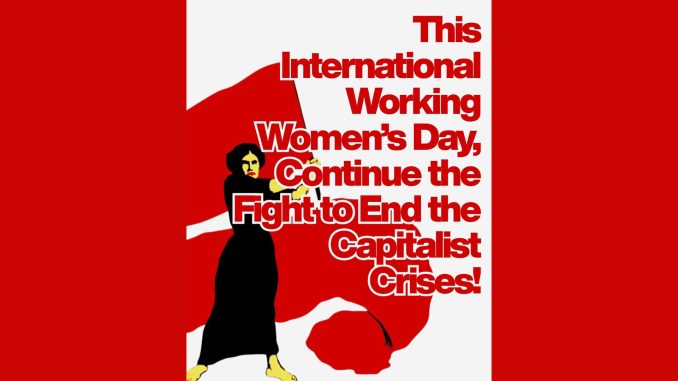
International Women’s Day, or International Working Women’s Day, was born out of struggle. First celebrated in 1911 after socialist revolutionary Clara Zetkin advanced the call at the Second International, the day was conceived as a rallying point for women workers across the world to unite in struggle. It drew inspiration from militant organizing by tens of thousands of women garment workers in New York who fought for union rights and dignity at work. In the years that followed, women across Europe took to the streets against the march toward world war, and in 1917 women textile workers in Russia launched strikes for “bread and peace,” helping ignite the February Revolution. From the very beginning, International Working Women’s Day was forged through the militant struggles of working women confronting exploitation and war.
Today, we face another deepening global economic crisis. Despite persistently stagnant – and in many cases declining – wages that suppress demand, especially for consumer goods, companies continue to outdo each other in producing ever more commodities in pursuit of ever greater profit. Mounting stockpiles of unsold goods have prolonged the crisis of overproduction across nearly all industries and, in turn, caused prolonged economic stagnation in the major capitalist countries. As a result, many industries are operating far below their productive capacity. This leads to widespread factory and business closures, massive layoffs, and worsening unemployment in not only Global North countries but also those in the Global South where unequal trade agreements and neoliberal policies have opened economies to intensified exploitation and the plunder of foreign capital. The majority of women, those who comprise half of the world’s toiling population, are among those hardest hit by this crisis.
Unable to resolve its recurring crises, the major capitalist powers increasingly turn to geopolitical confrontation. As profits stagnate in their own economies, they compete ever more aggressively to secure new markets, seize control of cheaper and more abundant sources of raw materials, and dominate emerging industries. In this context, economic sanctions, proxy wars, and military interventions become tools for managing the contradictions of capitalism. The ongoing aggression against Iran and the continued economic siege against Cuba are clear examples of how the United States attempts to preserve its capitalist dominance through coercion and destabilization. These escalating tensions reveal a system increasingly driven toward wider conflict. And in every such conflict, it is the toiling masses who suffer the most – especially women, who face heightened violence, displacement, and exploitation in times of war.
In the midst of this crisis, women workers and toiling people remain on the frontlines of resistance. From the protesting coffee workers in Brazil to the Starbucks workers on strike in the US; from the semiconductor factory workers in the Philippines to the online ride-hailing drivers in New Zealand; from the garment factories in Indonesia to the domestic workers in Hong Kong; women continue to organize and defend their communities against corporate plunder. Their struggles remind us that International Working Women’s Day stands as a testament to women’s historic role in the struggle for economic justice and liberation.
On this International Working Women’s Day, the People Over Profit network calls on women everywhere to continue the fight to end the capitalist crises and the capitalist system that produces it. The spirit of the women workers who marched and revolted over a century ago lives on today. Their legacy calls us to organize, resist exploitation, and stand together with all oppressed and toiling peoples in the struggle for a world free from war, plunder, and exploitation.