
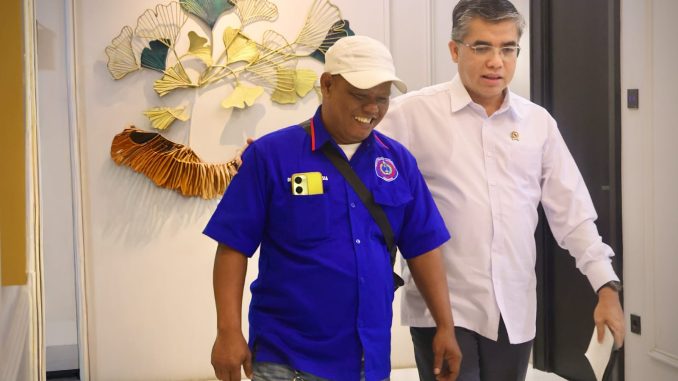
Jakarta, 10 February 2026 – Political pressure from the platform workers’ movement is beginning to yield a response. A day after protests at the ILO Indonesia office and the State Palace, the Indonesian Transport Drivers Union (SEPETA), together with the Simpul Rembuk Platform Workers Alliance, was received directly by Minister of Manpower Prof. Yassierli, ST., MT., Ph.D., and Director General of Industrial Relations and Social Security Development Dr. Indah Anggoro Putri, M.Bus., at the Ministry of Manpower office on Tuesday (10/2).
This meeting marked an important momentum in the struggle for recognition and protection of digital platform workers, who have long existed in a gray area of labor law.
SEPETA Chair Iwan Setiawan, together with Bangun Nugroho, emphasized that the state must not allow the power imbalance between platform companies and drivers to continue without regulatory correction.
“The state must not bow to digital platform business schemes that shift risks onto drivers. We work every day, yet our status and protections remain uncertain. This must end,” Iwan asserted.
Reject Unilateral KPIs as a Tool of Elimination, Push for a Profit-Sharing-Based Formula
In the discussion on the Holiday Bonus (BHR), SEPETA firmly rejected the Key Performance Indicator (KPI) scheme unilaterally designed by platform companies.
According to SEPETA, the defining characteristic of platform work is flexibility in working hours. If BHR eligibility requires drivers to be online 25 days a month, 8 hours per day, and to meet certain rating standards, millions of drivers will be systematically excluded.
“That is not protection — it is covert filtering. Flexibility is the core characteristic of our work. Therefore, the BHR formula must be based on profit-sharing and work participation over the course of a year, not unilateral KPIs used as a tool to eliminate ride-hailing drivers, online taxi drivers, and couriers,” Bangun Nugroho asserted.
He pointed to the implementation of BHR in 2025, when only 250,000 ride-hailing drivers, online taxi drivers, and couriers were verified and received the bonus out of 3.2 million digital platform workers across Indonesia.
SEPETA assesses that the use of rigid KPIs directly contradicts the narrative of flexibility that has long been used by platform companies as the foundation of their partnership model.
Government Pledges Coordination on Presidential Regulation and Reformulation of THR/BHR
During the meeting, the Minister of Manpower conveyed several key points:
First, regarding the Presidential Regulation (Perpres) on digital platform workers, the Ministry will coordinate once again with the State Secretariat to ensure the latest developments and current status of the regulation.
Second, regarding the 2026 THR/BHR policy, the government emphasized that the scheme to be used must be fairer, namely based on 20% of the average monthly income over the course of a year.
The government also stressed that there must be no discriminatory requirements that disadvantage drivers.
Third, the government stated its commitment to improving protection for women drivers, including in terms of safety and social protection.
Fourth, a dedicated BPJS Ketenagakerjaan claims hotline will be established to make it easier for drivers in emergency situations, including work-related accidents that occur outside formal working hours.
Fifth, the government is targeting the acceleration of the issuance of a law regulating digital platform workers this year as a form of legal certainty.
The Movement Will Continue to Monitor
The Simpul Rembuk Platform Workers Alliance emphasized that this meeting is not the end of the struggle, but rather the beginning of serious oversight of the government’s commitments.
SEPETA stated that without clear regulations, the relationship between app-based companies and drivers will remain unequal, with control over fares, algorithms, account suspensions, and profit-sharing entirely in the hands of the platforms.
“If the state is to be present, then it must be fully present. Not merely as a mediator, but as a guarantor of structural justice for millions of platform workers,” Iwan concluded. (ss-omh)