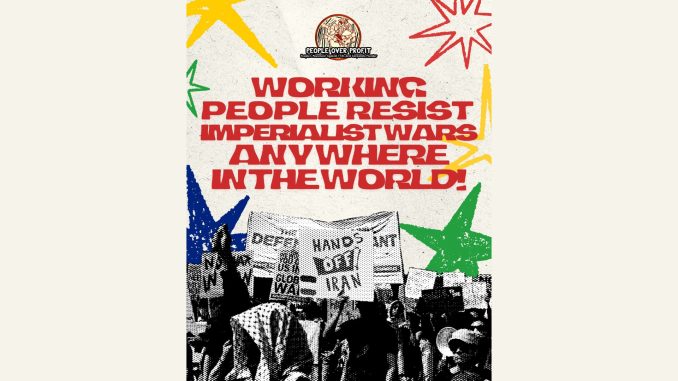
The People Over Profit network stands with the working people of the world in condemning the imperialist wars of aggression and intervention led by the United States, together with Israel, against the people of Iran, Venezuela, Cuba, and many more. These wars serve the interests of capital and profit, never those of working people – and it is the working class that is always made to carry the burden of the crises they create.
Following the attacks by US and Israel against Iran, the Strait of Hormuz- a vital maritime corridor through which nearly one-fifth of the world’s oil supply normally flows – has effectively been brought to a halt. The US-Israel attack on Iran created immediate disruption and shook global energy markets, destabilizing the broader global economy. Oil prices surged past $100 per barrel, while roughly 20 million barrels of oil per day were choked off from global markets. This marks the largest disruption to global oil supply since the 1956 Suez Crisis, when Britain, France, and Israel invaded Egypt, disrupting about 10% of global supply. Today’s crisis has already surpassed that scale.
The disruption, however, is not only about oil prices. Roughly 90% of global trade moves by sea, meaning disruptions to major maritime routes quickly ripple through supply chains worldwide. When transport becomes more costly, corporations simply pass those costs down to consumers. The result is predictable: everything becomes more expensive. The full impact may not be felt everywhere immediately, but over time, these price hikes will inevitably reach every working people across the world.
The economic shock is already spreading across key industries that underpin everyday life. Fertilizer production – essential for agriculture – relies heavily on natural gas, translating into higher food costs. The petrochemical industry is also hit, with key materials such as acrylic acids used in products like diapers becoming more expensive. The textile industry, which depends heavily on energy, is also under pressure. Heavy industries are likewise affeçted, as mining relies on fuel-powered equipment, glass production requires natural gas, and key materials such as aluminum and helium – essential for semiconductor manufacturing – are becoming more expensive amid supply disruptions. The hospitality sector is also feeling the impact, as restaurants and hotels depend heavily on commercial LPG sourced from West Asia, driving operating costs higher.
Across all these industries, corporations will respond in the same way they always do: passing rising costs onto consumers while protecting their profits. Once again, working people will be forced to shoulder the economic consequences of a war they did not start.
These economic pressures come on top of tax systems that already disproportionately burden the working class. In many countries, governments rely heavily on consumption taxes, a regressive system that taxes everyday goods and services rather than the corporations that produce them. These tax regimes were widely introduced and expanded during the structural adjustment programs imposed by the International Monetary Fund (IMF) and World Bank in the 1980s and 1990s, which pushed governments to shift revenue toward broad consumption taxes while reducing tariffs and taxes on businesses.
The result is a system in which working people are squeezed from multiple directions: rising market prices driven by imperialist wars of aggression, and tax systems squeezing working people dry. While corporations and wealthy elites remain largely shielded, ordinary people are forced to pay more simply to live. This war, therefore, adds yet another layer to the deepening crisis of cost-of-living faced by the working people across the world.
We call for an immediate end to wars of aggression and intervention led by the United States. We call for the immediate reduction of oil prices and the removal of consumption taxes that disproportionately burden workers and the toiling people. We must demand that governments take urgent measures to ease the pressure on working people rather than protecting corporate profits. The needs and livelihoods of the many must come before the profits of a few.